Researchers at Binghamton University, State University of New York, have developed skin-inspired electronics to conform to the skin, allowing for long-term, high-performance, real-time wound monitoring in users … “We eventually hope that these sensors and engineering accomplishments can help advance healthcare applications and provide a better quantitative understanding in disease progression, wound care, general health, fitness monitoring and more,” said Matthew Brown, a PhD student at Binghamton University … Biosensors are analytical devices that combine a biological component with a physiochemical detector to observe and analyze a chemical substance and its reaction in the body. Conventional biosensor technology, while a great advancement in the medical field, still has limitations to overcome and improvements to be made to enhance their functionality. Researchers at Binghamton University’s Intimately Bio-Integrated … read more
Month: March 2019
HydroCision® Announces Global Licensing Agreement with PROCEPT
BioRobotics, Providing Access to its Proprietary Pump Cartridge Technology
BOSTON and REDWOOD SHORES, Calif., March 26, 2019 /PRNewswire/ — HydroCision, a pioneer in the use of high velocity water jet technology for the minimally invasive treatment of musculoskeletal, spine and wound care conditions, today announced it has provided an exclusive worldwide license of its pump cartridge technology to PROCEPT BioRobotics for use in Urology … The agreement provides PROCEPT BioRobotics with the rights to use HydroCision’s innovative means of pumping high pressure fluids with their AquaBeam® Robotic System, the world’s first surgical robot providing autonomous tissue removal for the safe and effective treatment of Benign Prostatic Hyperplasia (BPH) … “This global agreement with PROCEPT BioRobotics is another significant and strategic step to bring the value of our differentiated technology into new surgical applications affecting millions of people around the world,” commented recently appointed HydroCision CEO, Alain Tranchemontagne. “This is yet another important validation of the value of our proprietary technology.” … read more
Venous Leg Ulcers: Frequently Asked Questions
In my recent WoundSource webinar on management strategies of venous leg ulcers (VLU), I discussed the complex pathophysiology of VLUs and procedural interventions that can help them reach closure … VLUs comprise the majority of lower extremity ulcers. These wounds are costly to treat and have a high rate of recurrence. Sequelae of VLUs include infection or sepsis risk, pain, loss of mobility, and possible amputation. Healing of VLUs requires an understanding of their multifactorial etiology, consideration of patient-specific risk factors, careful assessment, and best practice management for optimal clinical outcomes … The following categories of VLU prevention, management and treatment can help to answer some of the most frequently asked questions about VLU … read more
Neurovascular Response to Pressure in Patients With Diabetic Foot Ulcer
Diabetic foot ulcer (DFU) is a problem worldwide, and prevention is crucial. We hypothesized that the inability of the skin to respond to pressure is involved in DFU pathogenesis and could be an important predictive factor to take into account. We included 29 patients with DFU and 30 patients with type 2 diabetes without DFU. Neuropathy and skin blood flow at rest were assessed in response to acetylcholine, sodium nitroprusside, local heating (42°C), and to nonnoxious locally applied pressure. Results were compared with those obtained from 10 healthy age-matched control subjects. Vasodilatation in response to pressure was significantly impaired in both groups with diabetes compared with healthy subjects. The vasodilator capacity to pressure was significantly lower in patients with DFU compared … read more
Mechanism of impaired wound healing in diabetes identified
Researchers at Karolinska Institutet in Sweden have identified a mechanism that can explain the impaired wound healing in diabetes which can lead to diabetic foot ulcers. The study is published in the scientific journal Proceedings of the National Academy of Sciences. In diabetic mice, wound healing improved when the identified signalling pathway was blocked … Diabetic foot ulcerations are a common complication of diabetes that constitute a major medical, social and economic issue. The lifetime risk of a person with type 1 or type 2 diabetes developing a foot ulcer is around fifteen percent. The treatment options are currently … read more
Bacteria partners with virus to cause chronic wounds
A virus that infects a dangerous bacteria helps it thrive in wounds, according to a study by Stanford researchers. But a vaccine against the virus dramatically cuts the bacteria’s infectivity … A common bacterial pathogen called Pseudomonas aeruginosa produces a virus that substantially increases the pathogen’s ability to infect us, according to a study by investigators at the Stanford University School of Medicine … P. aeruginosa weaponizes its resident virus to exploit the immune system’s distinct responses to bacterial versus viral infections … read more
Janssen Submits Supplemental New Drug Application to U.S.
FDA for INVOKANA® (canagliflozin) for the Treatment of Chronic Kidney Disease in Patients with Type 2 Diabetes
The Janssen Pharmaceutical Companies of Johnson & Johnson announced today the submission of a supplemental New Drug Application (sNDA) to the U.S. Food and Drug Administration (FDA) seeking a new indication for INVOKANA® (canagliflozin) to reduce the risk of end-stage kidney disease (ESKD), the doubling of serum creatinine, which is a key predictor of ESKD, and renal or cardiovascular (CV) death in adults with type 2 diabetes (T2D) and chronic kidney disease (CKD). The submission is based on results from the Phase 3 CREDENCE (Canagliflozin and Renal Events in Diabetes with Established Nephropathy Clinical Evaluation) study, which evaluated the efficacy and safety of INVOKANA® versus placebo in this high-risk patient population when used in addition to standard of care.
Primary investigators will present the CREDENCE data during a late-breaking clinical trials session at the International Society of Nephrology (ISN) World Congress of Nephrology (WCN) Annual Meeting in Melbourne, Australia on April 15 at 8:30 am AEST (April 14 at 6:30 pm EDT in the U.S.). An open access live-stream of the late-breaking presentation can be accessed here (registration is required).
“Today, millions of people living with type 2 diabetes and chronic kidney disease are at high risk of experiencing kidney failure, and unfortunately, we have not seen treatment innovation for these patients in almost 20 years. Janssen’s application is a significant step toward bringing a much-needed, new standard of care for those living with these serious conditions,” said James List, M.D., Ph.D., Global Therapeutic Area Head, Cardiovascular & Metabolism, Janssen Research & Development, LLC. “We look forward to presenting the CREDENCE data at the ISN World Congress of Nephrology and working closely with the FDA to bring this important medicine as quickly as possible to people living with type 2 diabetes and chronic kidney disease.” … read more
Diabetic Limb Salvage Conference
Highly regarded as one of the world’s finest limb salvage events, MedStar Georgetown University Hospital’s DLS conference brings together the most eminent lower limb specialists for an unforgettable meeting. It is a multidisciplinary team approach meeting that provides each member of the healthcare team with the education and resources needed to heal wounds and prevent amputations. It features a prominent international faculty that promotes the importance of a multispecialty approach in limb salvage. The course highlights evidence-based approach with emphasis on take-home points, techniques, and functional outcomes …. read more
Advanced Therapies in Wound Management
With this initiative EWMA will investigate the barriers and possibilities of advanced therapies in the next generation wound management … The primary deliverable is a document including an introduction to the available technologies based on cellular therapies, tissue engineering and tissue substitutes, which are all technologies associated with the clinical discipline of regenerative medicine. The document also describes new treatments based on physical therapies and the potential of sensors and software … read more
Integra LifeSciences reveals FDA warning letter over chronic wound treatment
Integra LifeSciences (NSDQ:IART) today revealed its receipt of a warning letter sent by the FDA last week about quality system issues at a Boston-area plant that makes products to treat chronic wounds … Plainsboro, N.J.-based Integra said the FDA inspected the plant last October and November, resulting in a Form 483 covering the problems found there. The facility makes extracellular bovine matrix products that accounted for less than 4% of Integra’s sales last year, the company said … read more
Efficacy of Maggot Therapy on Staphylococcus aureus
and Pseudomonas aeruginosa in Diabetic Foot Ulcers
This study was conducted to evaluate the antimicrobial effects of medicinal maggots of Lucilia sericata on Staphylococcus aureus and Pseudomonas aeruginosa on diabetic foot ulcers (DFUs) … The sample comprised 50 adult patients from the clinic of the Academic Center for Education, Culture and Research of Tehran University of Medical Sciences, Iran. All participants who had at least 1 DFU present for at least 12 weeks, an arterial brachial index value of more than 0.6, and a hemoglobin A1c value of less than 8% were included in this study … read more
New interactive foot screening assessment now available online
Managing the growing incidence of diabetes in England is set to be one of the major clinical challenges of the 21st century. Estimates suggest that the number of people with diabetes is expected to rise to 4.2 million by 2030, affecting almost 9% of the population. More than 64 000 people with diabetes in England and Wales are thought to have foot ulcers at any given time. Around 7000 leg, foot or toe amputations are carried out each year in people with diabetes, with an estimated cost in 2014/15 at around £1 billion … read more
Identification and management of infection in diabetic foot ulcers
Diabetic foot ulcers (DFUs) are rising in prevalence globally, and particularly in the Gulf region. Infection remains a common and serious complication in managing DFUs. A need was identified for local guidelines that considered cultural and religious practices in the Gulf region, as well as clinical issues. This consensus document aims to provide practitioners with guidance on identifying and managing DFUs, which can be directly applied to local practice … download (pdf)
A Guide To Emerging Antibiotics For Multi-Drug Resistant Bacteria
The rise of bacteria that are resistant to multiple drugs highlights the urgency of developing new antibiotics to combat lower extremity infection. Accordingly, this author explores the potential of new pharmacological agents such as tedizolid, oritavancin, dalbavancin and delafloxacin, and discusses other agents in the pipeline … read more
Calculating The Benefits Of An Annual Diabetic Foot Exam
The benefits of having an annual comprehensive diabetic foot exam are too numerous to mention. If a patient sees his or her podiatrist along with one other member of the diabetic foot team, the relative risk reduction of a high level amputation will decrease, with some studies showing a reduction of as much as 80 percent … It’s a simple thing. Just the patient getting into see his or her foot doctor can yield significant benefits down the road. We outlined with the American Diabetes Association many years ago what goes into a good quality diabetic foot exam … read more
Peripheral arterial disease and the diabetic foot
Peripheral arterial disease (PAD) is a term used to describe atherosclerotic vessels in the periphery, mostly affecting the lower extremities. The blocked vessels impair blood and oxygen perfusion to the lower limbs and may lead to increased risk of ulceration, wounds and amputations. PAD is also associated with increased risk of coronary and cerebrovascular incidents. More than 50% of people living with PAD may not have any clinical symptoms, posing a challenge to diagnosis and management. This article will discuss the aetiology, presentation, risk factors, and management of PAD as related to the lower extremities … read more
Point-Counterpoint: Is Total Contact Casting Better Than
The CAM Walker Boot For Plantar Diabetic Wounds?
This author says total contact casts offer key biomechanical benefits, have extensive literature support and facilitate quicker healing of plantar diabetic foot ulcers … Offloading is one of the central concepts to healing the diabetic foot ulcer.1,2It is usually pressure (combined with neuropathy) that leads to an ulcer. Therefore, we must relieve the pressure in order to achieve wound healing … read more
MTF Biologics’ AmnioBand® Now Covered by Anthem
“We are pleased that Anthem is now covering our AmnioBand allograft solutions,” said Kim Rounds, Vice President of Wound Care at MTF Biologics. “As a nonprofit and the nation’s leading tissue bank, we are extremely pleased by Anthem’s decision to include AmnioBand for the treatment of diabetic foot ulcers. Our expanding portfolio, including viable cryopreserved placental membranes, ambient storage placental tissues, and AlloPatch® Pliable (a human derived reticular dermal matrix), provides wound care professionals and their patients with some of the most safe, clinically proven and cost effective treatment options for chronic wounds.”
Houston’s Third Annual Amputation Prevention Summit Scheduled for March 23rd
The third annual Amputation Prevention Summit will be held on Saturday, March 23, 2019 at Memorial Hermann Greater Heights, 1635 North Loop West, South Tower, First Floor, Houston, Texas, drawing clinicians from Houston and surrounding region. Memorial Hermann is the only health system in the Houston area that is part of the Amputation Prevention Centers of America® network … This CME event aims to highlight the urgent nature of the diabetes epidemic, the prevalence of peripheral arterial disease and diabetic foot ulcers, and how healthcare professionals can change and improve their practice in order to reduce lower extremity amputations … Diabetes is among the top 10 leading causes of death in Texas and the leading cause of non-traumatic lower extremity amputation. The risk of leg amputation for people with diabetes is 15 to 40 times greater than for a person without diabetes. Within two to four years of unilateral limb loss, one-third of all patients lose the other leg. Sadly, only about 50 percent of amputees survive within five years following a leg amputation due to ongoing complications of the chronic disease. With the future incidence of diabetes projected to rise to 550 million people worldwide by the year 2030, limb salvage is becoming a viable alternative, often producing better outcomes than amputation … read more
Vomaris Announces Launch of New Microcurrent-Generating Wound Care Product
Vomaris Innovations, Inc. reports the U.S. launch and first uses of a revolutionary new post-surgical wound dressing. Procellera® FlexEFit™ Antibacterial Wound Dressing employs a novel ‘Link & Build’ design that enables it to be ‘built’ during application to seamlessly cover incisions of virtually any length or curvature with just one product configuration. It is an important addition to Vomaris’s line of wound care products powered by V.Dox™ Technology. The only technology of its kind in the world, it employs embedded moisture-activated microcell batteries that wirelessly generate microcurrents designed to mimic the skin’s electrical energy … Procellera FlexEFit was first used by Orthopedic Surgeons Dr. Jimmy Chow and Dr. Brandon Gough, co-founders of the Orthopedic Institute of the West at Abrazo Scottsdale Campus in Phoenix, AZ … read more
Is Diabetic Footcare in the UK Still a ‘Cinderella’ Service?
Editor’s note. While this pertains to Great Britain and Whales, the concerns are universal.
We’ve got the background problem of foot ulcers and diabetes, which is a major problem and one which has been traditionally, perhaps, neglected by people, health care professionals. But we know it obviously causes tremendous suffering to the people who’ve got a foot ulcer, whether or not they go on to amputation, which is always the major threat … But it also is enormously expensive. And people don’t think of diabetic foot ulcers as being a major health care issue. And yet, care of diabetic foot ulcers we know costs at least a billion pounds each year to the NHS. That’s just about 1% of the total NHS budget, so it is an enormous problem, we know that … read more
Mobile bedside bioprinter can heal wounds
Imagine a day when a bioprinter filled with a patient’s own cells can be wheeled right to the bedside to treat large wounds or burns by printing skin, layer by layer, to begin the healing process. That day is not far off … Wake Forest Institute for Regenerative Medicine (WFIRM) scientists have created such a mobile skin bioprinting system — the first of its kind — that allows bi-layered skin to be printed directly into a wound … read more
Electrifying wound care: Better bandages to destroy bacteria
Bandages infused with electricity can help heal wounds faster than typical bandages or antibiotics—but for years, researchers have not really understood why … A recent study by a team at The Ohio State University is offering new clues about the science behind those bandages, and researchers say the findings could help lead to better wound treatment … The bandages belong to a class of therapies called electroceuticals, which are devices that use electrical impulses to treat medical issues such as wounds … read more
What Caused This Man’s Weakness and Hematuria?
A 52-year-old black man with type 2 insulin-dependent diabetes mellitus presents to hospital suffering from significant weakness and nausea; he says he has had no appetite for the past week, but has not been vomiting. He reports seeing blood in his urine, and that his urinary output has decreased … He looks very ill but shows no signs of distress – he is mentally alert and aware of his surroundings. He does not use over-the-counter medications or herbal remedies, nor does he smoke, drink alcohol, or use any illicit drugs … read more
Australian study shows specialist clinics are cost-effective
for chronic wound care
Average saving of $3,947 per patient, and increased patient quality of life also reported … A study published in PLOS ONE by academics in Australia and the UK, shows that specialist wound management clinics are the most cost-effective route for the care of chronic wounds with better results for patients … The research team includes Dr Rosana Pacella, Head of Research at the University of Chichester, West Sussex, UK as part of an international health economics collaboration including Dr David Brain, and other researchers at the Queensland University of Technology … read more
Mobile bedside bioprinter can heal wounds
Imagine a day when a bioprinter filled with a patient’s own cells can be wheeled right to the bedside to treat large wounds or burns by printing skin, layer by layer, to begin the healing process. That day is not far off … Wake Forest Institute for Regenerative Medicine (WFIRM) scientists have created such a mobile skin bioprinting system — the first of its kind — that allows bi-layered skin to be printed directly into a wound … read more
Maggots: Hong Kong reports two human myiasis cases
According to the Centers for Disease Control and Prevention (CDC), myiasis is infection with a fly larva, usually occurring in tropical and subtropical areas … There are a number of ways to contract it–getting an infection from accidentally ingesting larvae, from having an open wound or sore, or through your nose or ears. People can also be bitten by mosquitoes, ticks, or other flies that harbor larvae. In tropical areas, where the infection is most likely to occur, some flies lay their eggs on drying clothes that are hung outside … read more
Negative pressure wound therapy promoted wound healing
by suppressing inflammation via down-regulating MAPK-JNK signaling pathway in diabetic foot patients
Negative pressure wound therapy displayed significant clinical benefits in the healing of diabetic foot wounds. In the present study, we investigated the mechanism of regulation of MAPK-JNK (Mitogen-activated protein kinase- c-Jun N-terminal kinase) signaling pathway by negative pressure wound therapy on these wounds …
Read the full article on Diabetes Research and Clinical Practice
Randomized Clinical Study Assessing NuShield Versus
Standard of Care in Diabetic Foot Ulcers (DFUs)
This prospective, multi-center, randomized, controlled clinical study compares NuShield® plus SOC to SOC alone in subjects with chronic DFUs. NuShield® will be used along with standard of care on diabetic foot ulcers of greater than 6 weeks which have not adequately responded to conventional ulcer therapy … One hundred and twenty five (125) subjects with a chronic DFU ranging in size from 0.5cm2 and 25 cm2 will be randomized 1:1 to either NuShield® and SOC or SOC alone following the 14 day screening period. Following screening and randomization, subjects shall be seen weekly for up to 24 weeks. For subjects that heal prior to week 24, a healing confirmation visit shall occur two weeks later to confirm maintenance of complete wound closure … read more
Reimbursement for Total Contact Casting and Debridement
Few things in life are more complicated than medical reimbursements, we believe this (table below) to be accurate for TCC based on how current clients are billing. Also this is from SuperCoder on debridement:
As per NCCI edits total contact cast application (29445) cannot be billed separately from a debridement (97597) when treating the same ulceration/same anatomical location for medicare as of above scenario. However, Commercial payers may consider separate payment with appropriate modifier.
Also from SuperCoder on CPT codes for debridement:
CPT code 97602 can be used for removal of devitalized tissue from wounds when non selective debridement (chemical method, hydrogen peroxide, iodine, Pulsed lavage method etc.) method is performed.
CPT codes from wound debridement series (11042 – 11047) can be used if active debridement is performed with surgical instruments (forceps and scissors to remove infected or dead tissue material from the wound). Here code selection depends on the depth of the tissue removed e.g. for debridement up to level of subcutaneous tissue – CPT code 11042 is the correct CPT code.
This from medicarepaymentandreimbursement.com on reimbursement fees:
11042-Debridement, subcutaneous tissue (includes epidermis and dermis, if performed); first 20 square cm or less. – average fee payment- $120 – $130
From Integra Life Sciences:
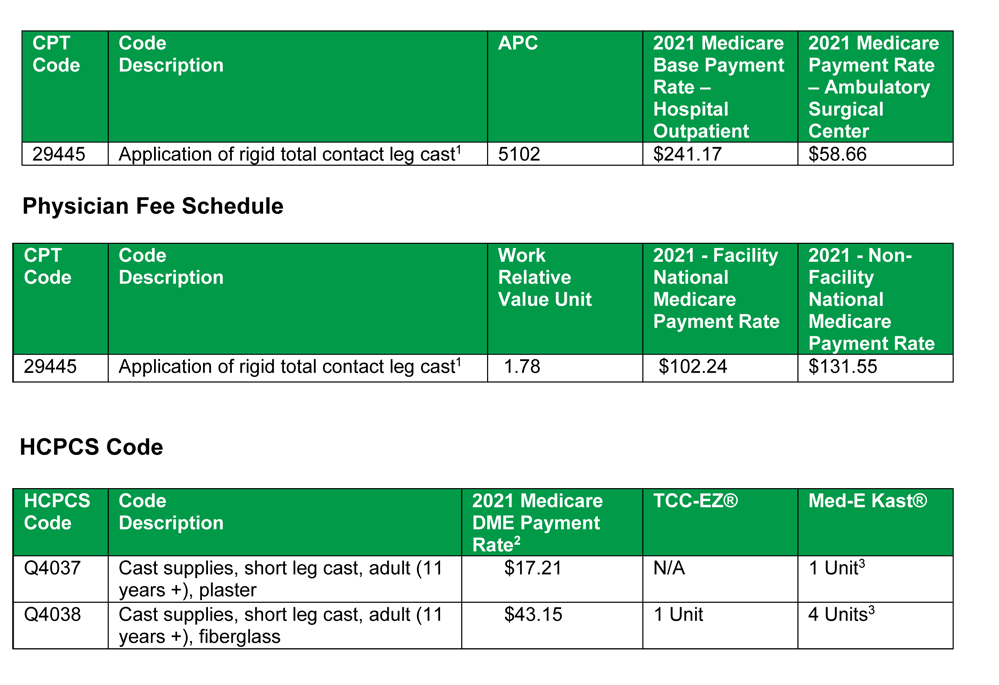
- Coding/Billing Notes:
According to the National Correct Coding Initiative (CCI) Policy Manual for Medicare Services (Revision
Date: 01/01/2017), casting/splinting/strapping should not be reported separately if a restorative treatment
or procedure to stabilize or protect a fracture, injury, or dislocation and/or afford comfort to the patient is
also performed. Several examples follow: (1) If a provider injects an anesthetic agent into a peripheral
nerve or branch (CPT code 64450), the provider should not report CPT codes such as 29515, 29540, or
29580 for that anatomic area; (2) A provider should not report a casting/splinting/strapping CPT code for
the same site as an injection or aspiration (e.g., CPT codes 20526-20615); (3) Debridement CPT codes
(e.g., 11042-11047, 97597) and grafting CPT codes (e.g., 15040-15776) should not be reported with a
casting/splinting/strapping CPT code (e.g., 29445, 29580, 29581) for the same anatomic area. - If the cast is supplied by the physician in his/her office, the physician may bill the Medicare for the
application of the cast as well as the supply of wrap itself, not the actual boot, during instances where just
an application of TCC is occurring and the physician is enrolled in Medicare as a licensed DME Supplier.
Reference: CPT® Code Book 2021. Current Procedural Terminology (CPT) copyright 2020 American
Medical Association (AMA). All rights reserved. CPT is a registered trademark of the AMA. Fee
Schedules, relative value units, conversion factors and/or related components are not assigned by the
AMA, are not part of CPT, and the AMA is not recommending their use. The AMA does not directly or
indirectly practice medicine or dispense medical services. The AMA assumes no liability for data
contained or not contained herein.